

I owe Jan Robert Go, Enrico Gloria, and Jely Galang an apology because some readers took my WPS article as questioning their integrity. Some people read the discussion as an argument about Chinese infiltration, while a friend told me that by naming these scholars, I was implying that I considered them compromised or less credible (no, I was not implying that at all. That’s the wrong reading!). One former Philippine military officer now living in the United States even described the issue on LinkedIn as infiltration, which made me laugh because I thought I had written something substantially different. I am sorry that scholars I respect became associated with claims about loyalty, infiltration, or credibility that I did not intend to make (and yes, I wrote to them separately yesterday).
I am still trying to understand why readers reached those conclusions because several explanations seem plausible. Some of the problem may come from my writing, although my long publication record gives me some confidence that I usually communicate complicated China-related arguments clearly to academic and policy audiences. I also asked several colleagues and professor friends to read the WPS article specifically to see whether the epistemic-narrowing point was clearly separated from the other vulnerabilities, and they thought it was. None of them were Filipino, though, so they may not have brought the same context or assumptions to the piece.
Some readers may have compressed a dense argument about epistemic constraints into more familiar categories involving infiltration, foreign influence, or compromised scholars. The space constraint also mattered because epistemic narrowing probably needed around 1,500 words to demonstrate properly, while I had roughly 200 to 300 words for that point inside a 1,200-word article covering several vulnerabilities and policy responses. Putting Chinese funding, epistemic narrowing, and counterintelligence-related risks inside the same short piece increased the possibility that readers would collapse analytically distinct mechanisms into one argument. Despite all of this, I bear the most responsibility for clarity because readers should not need a second essay to reconstruct what I meant in the first one.
Why I named them
First, I do not regret naming Go, Gloria, and Galang because the point required real cases that readers could examine for themselves. If I had referred vaguely to Filipino scholars trained in China, readers could reasonably ask which scholars demonstrated the mechanism and whether the problem existed beyond an abstraction. Their educational histories, research interests, and professional trajectories are public, which means interested readers could identify relevant scholars even without explicit names. Naming them made my interpretation concrete enough for other researchers to inspect the evidence, challenge my cases, and show where my reasoning might fail.
Second, I deliberately departed from a Filipino norm in which disagreements involving identifiable people are often handled privately or softened to preserve relationships. That norm has value because small academic and professional communities depend heavily on collegiality, repeated interaction, and personal trust. Having grown up in different places and now being outside both academia and Philippine social life, I have never really shared that norm or felt especially comfortable with it. I think some deviation becomes particularly important when disagreements concern national security because private conversations can leave consequential claims, evidence, and assumptions insulated from scrutiny.
Philippine scholarship can benefit from more space for substantive disagreement because important arguments often circulate through private messages, side conversations, and personal networks that most readers cannot evaluate. If Go, Gloria, Galang, or anyone else thinks I selected the wrong cases, misunderstood their scholarship, exaggerated institutional effects, or failed to demonstrate the mechanism, those objections should be stated clearly enough for other researchers to assess. This already happened on X when one reader defended Galang’s inclusion in my discussion, which opened the claim itself to public scrutiny. Public disagreement carries interpersonal costs, although those costs can be worth accepting when the stakes extend beyond professional relationships and the underlying evidence can be tested.
Third, I chose serious scholars because weaker examples would have made the point easier to dismiss. If I had selected people producing poor scholarship or obvious political advocacy, readers could attribute any narrowing to weak methods, ideological preference, limited training, or individual political commitments. Go, Gloria, and Galang allow the discussion to hold research quality relatively constant because each has developed serious expertise on China-related questions. Their cases allow us to ask what capable scholars can know when institutions shape the evidence, mentors, professional networks, and research environments available to them.
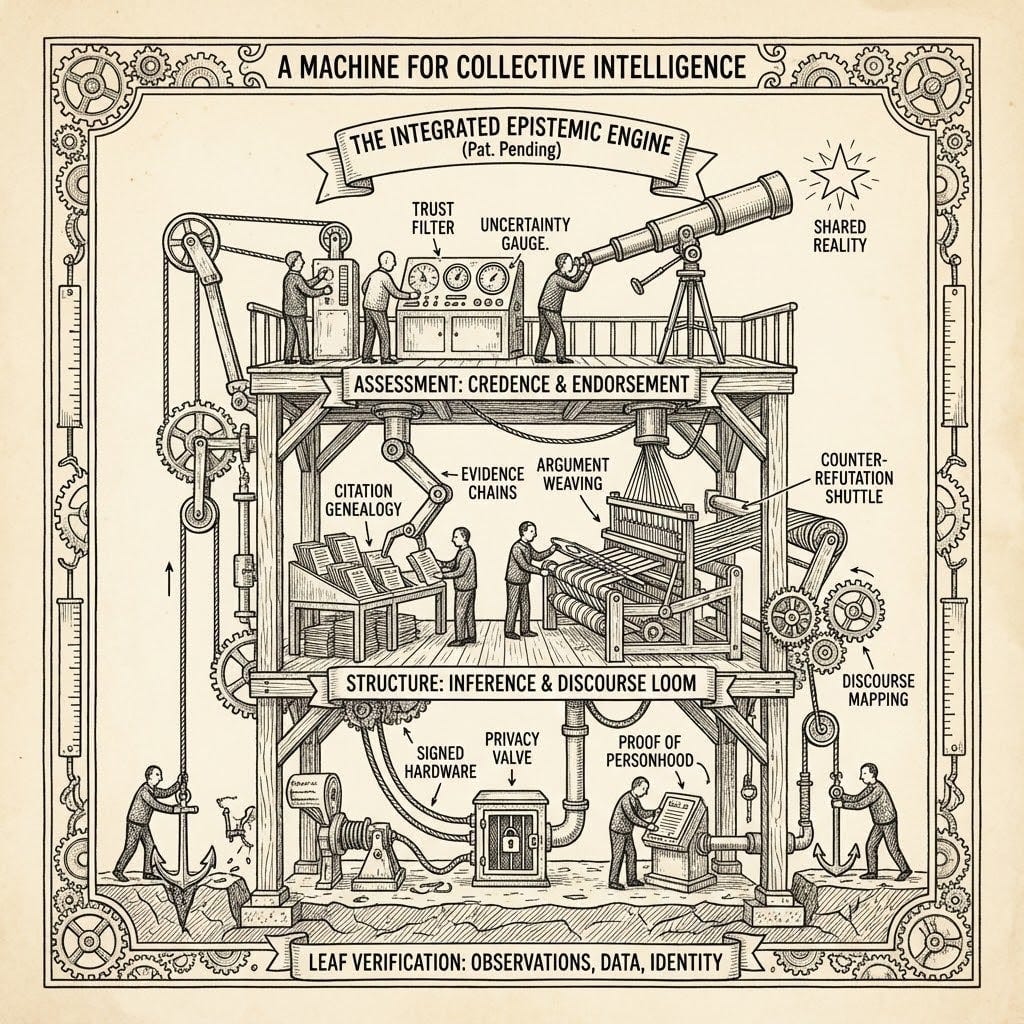
Epistemic narrowing begins before interpretation because institutions help determine which evidence enters a researcher’s universe and which questions become realistic research projects. Bias concerns how a scholar evaluates evidence after obtaining it, while institutional environments influence which evidence repeatedly becomes available for evaluation in the first place. A researcher can remain rigorous, skeptical, intellectually independent, and completely sincere while becoming extraordinarily knowledgeable about one dimension of China and comparatively unfamiliar with another. This process requires no direction from anyone because specialization itself concentrates attention around particular subjects, sources, professional relationships, and methods.
How my own epistemic communities changed
My own career illustrates this process because different intellectual communities repeatedly changed which dimensions of China I encountered most frequently. Ho-fung Hung, my supervisor at Johns Hopkins University, was there from the beginning, although it took time for his influence to fully shape how I understood China’s global economic positioning, domestic political economy, structural contradictions, and limits. During my early academic work, Kevin Gallagher, Deborah Brautigam, and later Kelly Sims Gallagher placed development, infrastructure, finance, energy, and host-country outcomes much closer to the center of my research universe. Over time, Ho-fung became my largest academic influence, while my later move into defense technology changed the environment again because DoW offices and other defense customers now place US national interests, supply-chain vulnerabilities, and strategic competition much closer to the center of my daily work.
In 2019, I worked within Kevin Gallagher’s Global China Initiative at Boston University’s Global Development Policy Center, where Chinese development-finance, overseas lending, infrastructure, and development outcomes shaped much of the research agenda. During my Johns Hopkins University years, I also interacted repeatedly with Deborah Brautigam and participated in the wider intellectual community around SAIS-CARI and Chinese development finance. Those communities gave me unusually deep exposure to Chinese lenders, projects, recipient governments, and debates surrounding the developmental consequences of Chinese capital. That exposure made development finance one of the strongest parts of my research because years of interviews, datasets, conferences, and professional networks accumulated around those questions.
Kevin Gallagher and Deborah Brautigam made me substantially better at studying Chinese development because their research environments emphasized careful empirical investigation of how Chinese capital operated overseas. Their work made it difficult to reduce every Chinese loan, firm, or infrastructure project to geopolitics because commercial incentives, host-country bargaining, and development objectives repeatedly appeared in the evidence. My own research consequently spent years examining infrastructure, investment, host-country politics, elite bargaining, and development outcomes across Southeast Asia. That training still makes me cautious when strategic explanations move faster than the evidence supporting them.
My Carnegie Endowment for International Peace paper on the Kaliwa Dam provides one example. In “How Duterte Strong-Armed Chinese Dam-Builders But Weakened Philippine Institutions”, I argued that Philippine political elites were central to the project because Duterte administration officials pursued domestic objectives while Chinese lenders and contractors accommodated important Philippine demands. Philippine elites consequently shaped project design and institutional outcomes because Chinese actors entered a political environment where host-country officials possessed their own incentives and bargaining power. That case reinforced my tendency to look for local political agency before treating Chinese infrastructure as something controlled exclusively from Beijing.
My work with Angela Tritto pushed the same host-country approach across a wider set of Southeast Asian cases. In our Journal of Contemporary China article, “The Belt and Road Initiative in Southeast Asia: A Mixed-Methods Examination”, we examined how diplomatic relationships and host-market conditions shaped patterns of Chinese investment across the region. Our related World Development Perspectives article, “State-facilitated Industrial Parks in the Belt and Road Initiative: Towards a Framework for Understanding the Localization of the Chinese Development Model”, showed how Chinese development models changed after encountering local governments, firms, regulations, and political bargains in Indonesia and Malaysia. Those projects kept development, localization, and host-country agency near the center of my research because Chinese capital repeatedly produced different outcomes after entering different political economies.
My Third World Quarterly article with Guanie Lim and Kevin Gallagher extended this approach into mineral processing and industrial policy. In “Leading Sector and Dual Economy: How Indonesia and Malaysia Mobilised Chinese Capital in Mineral Processing”, we examined how both governments used Chinese capital to pursue industrial objectives under different political-economic conditions. Chinese firms provided capital, processing capacity, technology, and infrastructure, while Indonesian and Malaysian institutions shaped how those resources entered national development strategies. Similar sources of Chinese capital produced different industrial outcomes because the host-country political economies differed.
In 2020, another intellectual environment entered my work when I joined Kelly Sims Gallagher’s Climate Policy Lab at The Fletcher School at Tufts University as a faculty affiliate. Kelly’s research agenda emphasized climate policy, energy transitions, green industrialization, and US-China economic relations, which pushed me to connect development strategies with the material requirements of decarbonization. Infrastructure could no longer appear only as a development outcome because cement, steel, energy systems, and industrial capacity also carried major climate consequences. That environment added another set of questions because development and decarbonization increasingly became parts of the same political-economic problem.
My Energy Research & Social Science article, “Cementing Development and (Un)Steeling Decarbonization: The Political Economy of Infrastructure Drive in Duterte’s Philippines”, reflects that shift because it examined Duterte’s infrastructure program through cement and steel. Philippine infrastructure expansion increased demand for both materials, those industries remained highly carbon intensive, and existing production structures made rapid decarbonization difficult. My paper with Steven Gu, “What Large-Scale Infrastructure Initiatives, Cement, and Steel Mean to the Global Decarbonization Initiative”, extended the problem beyond the Philippines by examining how infrastructure expansion increased demand for two sectors that remain extremely difficult to decarbonize. Kelly’s intellectual environment therefore made industrial materials, energy systems, and climate constraints much harder for me to leave outside a development analysis.
Those three influences concentrated much of my early work around development, infrastructure, host-country politics, industrialization, and climate policy. Kevin Gallagher exposed me to the developmental consequences of Chinese capital, while Deborah Brautigam reinforced the importance of detailed empirical work capable of challenging simple geopolitical explanations. Kelly Sims Gallagher added energy transitions, material constraints, and decarbonization to that research universe. Those communities made my work substantially stronger because each made particular questions and forms of evidence much easier for me to see.
Over time, Ho-fung Hung became the largest academic influence on how I understood China because he changed the level at which I asked many of these questions. Ho-fung pushed me to locate Chinese overseas behavior within China’s changing position in the global economy and within the contradictions of its domestic political economy. His scholarship made me think much more seriously about the limits of China’s growth model, the pressures created by accumulation, and the relationship between domestic economic structures and external behavior. That influence gradually moved me away from development finance as the principal center of my intellectual agenda.
My Development and Change article, “The Sino-centric Capital Export Regime: State-backed and Flexible Capital in the Philippines”, reflects Ho-fung’s influence most directly. The article begins with structural pressures inside Chinese capitalism because overaccumulation and excess productive capacity created incentives for different forms of Chinese capital to move abroad. Those capital forms then interacted with host governments, firms, political coalitions, and local institutions, which produced different outcomes across sectors and countries. Ho-fung shaped that causal architecture because he taught me to begin with China’s domestic political economy before tracing how those pressures materialized overseas.
My recent Foreign Affairs article, “Why Criminals Love the Chinese Economy”, carries the same intellectual influence into a very different empirical domain. Strict capital controls create demand for informal financial channels, industrial scale provides commercial infrastructure, and overcapacity creates goods and networks that illicit actors can exploit. Those conditions then interact with underground bankers, scam syndicates, sanctions evaders, and organized criminal groups operating across borders. The subject moved far beyond development finance, although the causal architecture still begins with domestic structures before tracing the external behaviors those structures make easier.
Ho-fung’s influence connects these two pieces because both begin with the political economy inside China before moving outward. The Sino-Centric capital export paper asks how structural pressures generate outward capital, while the Foreign Affairs article asks how structural features of China’s economy create opportunities that illicit actors exploit internationally. That way of thinking eventually became more important to my research than development finance alone. I moved away from my earlier development and climate-policy environments without discarding their empirical lessons.
My intellectual environment changed again when I left academia and moved into US defense technology, where DoW offices and other defense institutions are among the customers for the technology and research my company develops. I do not work for the DoW because my role is within a private defense-technology company serving organizations across the US defense industrial base. My daily work nevertheless exposes me to Pentagon-related requirements, industrial-base vulnerabilities, supply-chain dependencies, critical materials, transshipment, technology risks, and illicit networks because those are problems our customers are trying to solve. That exposure has made security questions much more central to how I encounter China than they were during most of my academic career.
The defense-technology environment has changed the frame through which I instinctively evaluate problems because US national security now enters my work almost every day. When customers care about military supply chains, American industrial vulnerabilities, strategic competition, economic security, and defense production, it becomes difficult to examine China without asking what a particular development means for US national security. That perspective makes vulnerabilities (for Americans and our allies) much more visible because defense customers routinely surface risks that development-finance communities rarely placed near the center of their research agendas. US national security can become a very powerful organizing frame when it structures the problems, datasets, and conversations surrounding most of the working day.
I am particularly mindful of this influence because defense technology forms another epistemic community whose assumptions can narrow attention. USG-related work naturally foregrounds strategic competition, adversarial behavior, chokepoints, industrial weakness, coercive possibilities, illicit networks, and worst-case scenarios because defense institutions need to identify vulnerabilities before those vulnerabilities become operational problems. My development work reminds me that Chinese firms and banks can pursue commercial and developmental objectives, while Ho-fung’s influence keeps me attentive to China’s domestic constraints and structural limits. My current defense work forces me to examine US national interests and security vulnerabilities that I treated much more peripherally earlier in my career.
In other words, American institutions produce epistemic narrowing too because universities, foundations, think tanks, government agencies, companies, and defense organizations organize knowledge around different mandates. Institutional pluralism provides an important corrective because researchers can move among communities that disagree substantially about China, development, climate, security, political economy, and US-China relations. My own trajectory benefited from that pluralism because each intellectual move exposed problems that earlier environments had placed outside the center of my attention. I am still shaped by every one of these communities, which is why I try to remain conscious of what my current environment makes easier or harder for me to see.
Why the PRC environment is different
Chinese universities face a more consequential version of this problem because ordinary specialization operates inside political boundaries that extend across the wider university system. The Chinese Communist Party’s 2021 regulations governing Party organizations in universities state that university Party committees exercise overall leadership over university work and place educational direction, personnel, and ideology under Party leadership. Those regulations also explicitly connect Party-building with teaching, scientific research, international exchange, and other university functions. As such, political authority operates across the institutional system in a way that differs from the competing mandates of individual universities, foundations, think tanks, or research centers in more plural academic environments.
Chinese universities still produce excellent scholarship because they offer language immersion, institutional access, local knowledge, Chinese scholarship, officials, firms, professional networks, and datasets that researchers abroad often cannot reproduce. Those advantages can make scholars exceptionally sophisticated on subjects where sustained access generates large amounts of observable evidence. The problem becomes more consequential when politically sensitive subjects generate thinner evidence because respondents cannot speak safely, documents become inaccessible, or particular questions create greater professional and political risks. Individual methodological skill can compensate for many research limitations, although researchers cannot fully reconstruct evidence that they cannot safely observe.
First, evidence asymmetry is measurable in research on scholars working on China. In “Repressive Experiences among China Scholars: New Evidence from Survey Data”, Sheena Chestnut Greitens and Rory Truex surveyed 562 China scholars and found that 26 percent of scholars using archival methods had encountered denied access to archives or materials. Among scholars conducting interviews or participant observation, 17 percent had experienced interview subjects withdrawing without explanation, while roughly 9 percent of respondents reported being questioned by authorities through what China scholars commonly call being “invited to tea.” These experiences were far from universal, which matters because epistemic narrowing does not require every scholar to experience direct repression before access becomes uneven across subjects.
The same survey shows how researchers adapt when political boundaries become uncertain. Almost 49 percent reported using different language to describe projects inside China, around 24 percent had shifted a project away from its most sensitive aspects, and 15.5 percent reported abandoning a project entirely. Seventy percent of respondents agreed that self-censorship was a problem in the China field, although the authors carefully note that scholars often modify behavior to protect respondents and colleagues rather than to protect their own careers. The causal mechanism still matters because political risk changes which questions researchers pursue, how they present those questions, and which evidence can safely enter the research process.
Second, political boundaries can shape the material available for scholarly debate even after research has been produced. In 2017, Chinese authorities requested that Cambridge University Press make more than 300 pieces from The China Quarterly inaccessible through its Chinese website, which Mathew Wong and Ying-ho Kwong subsequently analyzed in their study of academic censorship. The targeted list concentrated heavily on politically sensitive subjects involving Mao, the Cultural Revolution, Tiananmen, Tibet, Taiwan, Xinjiang, and Hong Kong. The important feature is selectivity because political boundaries did not make all China research equally inaccessible. They disproportionately affected particular parts of the research universe.
A much larger dataset identifies the same selectivity inside China’s intellectual public sphere. In “Censoring the Intellectual Public Space in China”, Xiaojun Yan and La Li analyzed 144,280 intellectual articles written by 28,494 authors between 2000 and 2020, including 5,406 articles by 769 authors that had been deleted following instructions from state regulators. Their analysis finds that censorship was systematically more likely when writing challenged official national policies, state historiography, or values promoted by the state. Put simply, political control affects particular arguments and topics more heavily than others, which can make some dimensions of Chinese politics easier to develop into sustained intellectual literatures than competing dimensions.
Third, these effects can eventually change the distribution of published academic knowledge. In “Disappearing Research: Academic Control and Self-Censorship in China”, Ning Leng and Elizabeth Plantan combine interviews with scholars and students affiliated with Chinese universities with an analysis of more than 5,000 hand-coded publications produced between 1985 and 2022. They find that some research topics effectively disappeared over time, while others migrated from Chinese-language publications into English-language venues as political controls changed. Their evidence also shows that US-based scholars are not completely insulated from these pressures, which is important because dependence on access can transmit the effects of a constrained research environment beyond the institutions physically located inside China.
These findings establish a step-by-step mechanism that is much closer to what I meant by epistemic narrowing than an argument about individual political bias. Political authority first creates unequal risks across topics, which changes access to respondents, archives, publications, and professional relationships. Researchers then adapt projects and methods because some questions become more difficult, risky, or expensive to pursue. Over time, the resulting publication record becomes richer around subjects with stronger access and thinner around questions where evidence repeatedly becomes unavailable.
That process can also create asymmetric hypothesis testing because researchers can only test explanations using evidence they can realistically observe. A scholar studying a Chinese overseas project may obtain financing documents, official development plans, company records, and interviews with policymakers that allow commercial or developmental explanations to be evaluated with substantial precision. Testing whether political influence, intelligence relationships, informal elite bargains, or coercive considerations also shaped the same project may depend on records or respondents that are substantially harder to access. The stronger evidence available for the first explanation does not prove a competing explanation correct, although the institutional environment partly determines how rigorously each hypothesis can be tested.
These differences become cumulative because graduate students inherit mentors, datasets, conferences, professional networks, established debates, and publication pathways from earlier generations of scholarship. Subjects with strong access can become increasingly sophisticated as each generation receives better data and deeper professional relationships. Politically difficult subjects may develop thinner research infrastructures because fewer scholars can accumulate comparable evidence around them. Political authority can affect the eventual distribution of knowledge without directing every researcher toward a predetermined conclusion.
The comparative difference concerns the number of institutional environments capable of correcting what another community overlooks. American universities, development organizations, climate-policy centers, human-rights organizations, investigative groups, think tanks, businesses, and defense institutions all generate their own forms of epistemic narrowing because each privileges particular problems and forms of evidence. Researchers can still move between communities whose assumptions differ considerably, which creates opportunities for one institutional environment to expose what another one neglects. My own career benefited from exactly that movement because development finance, climate policy, structural political economy, and defense technology repeatedly made different aspects of China visible to me.
This is why I used Go, Gloria, and Galang because their seriousness makes the structural mechanism visible without requiring any claim about their integrity. I am not claiming that their scholarship reproduces Chinese government positions because serious researchers can recognize access problems, triangulate sources, and compensate through careful methodological choices. Individual skill eventually reaches a limit when respondents cannot speak safely, archives remain closed, or competing explanations cannot be evaluated with comparable evidence. The empirical research on Chinese knowledge production matters precisely because it shows that these asymmetries can emerge even when talented scholars are working carefully, independently, and completely in good faith.
In sum, the Philippines needs substantially more China expertise across a wider range of institutional and geographic spaces because PRC institutions are becoming increasingly important within the architecture through which that expertise is built in the Philippines, across Southeast Asia, and globally. Chinese universities, scholarships, research funding, training programs, institutional partnerships, mentorship networks, language opportunities, and access to China now occupy a growing share of the pathways available to scholars studying the country. Philippine institutions therefore need more scholars developing China expertise through China itself, while also expanding serious China research through Taiwan, Japan, Singapore, Australia, Europe, the United States, and other Southeast Asian research environments. A stronger Philippine China-studies ecosystem should expose scholars to multiple bodies of evidence, intellectual traditions, mentors, and institutional networks so that expertise deepens without becoming concentrated inside any single research environment.
I do not regret raising this question or grounding it in identifiable cases because the mechanism needed real scholars whose trajectories readers could examine and contest. I do regret that Go, Gloria, and Galang (could have) felt that I was questioning their integrity because that was never the claim I intended to make. If my compressed treatment made that interpretation easier, I should have explained the distinction more fully because 200 to 300 words could not demonstrate the mechanism with sufficient precision. My apology concerns the hurt and ambiguity created by that compression, while my substantive concern about the institutional production of China expertise remains unchanged.
My own trajectory makes me more conscious of this problem because Kevin Gallagher, Deborah Brautigam, Kelly Sims Gallagher, Ho-fung Hung, and the defense-technology world have each changed what I notice about China. Development-finance research pushed me toward projects, recipient governments, and development outcomes, while climate-policy work added industrialization, energy systems, materials, and decarbonization. Ho-fung shifted my attention toward China’s global economic positioning, domestic contradictions, and the structural sources of its external behavior. Working with USG offices and other defense customers now pushes me toward US national interests and strategic vulnerabilities, which gives me another epistemic environment whose assumptions I need to examine as carefully as the ones that shaped me before.